From Elo to Glicko-2: a short history of skill ratings
How Elo, Glicko and Glicko-2 work, what each one added, and what came after them, with worked examples from a real rating engine.
Every ranked game has to answer the same question after every match: given these results, how good is each player? The answer chess adopted in 1960, the Elo rating system, is still widely used. Two later systems, Glicko and Glicko-2, build on it. The short version:
- Elo gives every player one number, their rating.
- Glicko adds a second number that says how sure the system is about the rating.
- Glicko-2 adds a third that says how consistent the player's results are.
This post walks through all three in order, then looks briefly at what came after them. We ran the worked examples on Inhouse's rating engine with its default settings, so these are the same numbers a real game would get.
Before Elo
Chess had ratings before Elo. West Germany used the Ingo system from 1948, in which a lower number meant a stronger player, and the US Chess Federation adopted the Harkness system in 1950. Both turned tournament results into numbers using rule-of-thumb formulas. Neither was based on a model of how likely one player is to beat another, and that is what Elo added.
Elo: a rating that predicts results
Arpad Elo was a Hungarian-American physics professor and a chess master. The US Chess Federation adopted his rating system in 1960, and FIDE, the international chess federation, followed in 1970.
Elo started from the observation that nobody plays at exactly the same strength every game. Everyone has good days and bad days, so the stronger of two players won't win every time. They will win more often, though, and the bigger the gap in strength, the more often. That makes the gap between two players' ratings a prediction of how a game between them is likely to go.
Most software today uses this form of his formula, for a player rated Ra against an opponent rated Rb:
E   = 1 / (1 + 10^((Rb - Ra) / 400))
Ra' = Ra + K × (S - E)
The first line is the prediction. E is the player's expected score, on a scale where 0 is a certain loss, 0.5 is an even match and 1 is a certain win. (Elo's own work used a normal, bell-shaped curve where this formula uses a logistic one. The two make very similar predictions.)
The 400 sets the scale. A player who is 200 points ahead has an expected score of 0.76, or 76%, and a player 400 points ahead has about 91%:
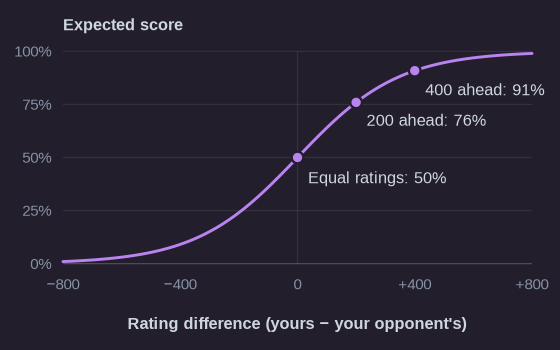
The second line is the update. S is what actually happened: 1 for a win, 0.5 for a draw, 0 for a loss. So S − E is how far the result was from the prediction, and the rating moves by that amount multiplied by K, a constant that sets the size of the swings. An expected result moves a rating only a little, and an upset moves it a lot.
Take a player rated 1500 against one rated 1700, with K = 32 (Inhouse's default for ratings between 1500 and 2500). The formula gives the 1500 player an expected score of 0.24, or roughly one win in four.
- If the 1500 player wins anyway, they gain 32 × (1 − 0.24) ≈ 24 points, and the 1700 player loses the same 24.
- If the 1700 player wins, as expected, they gain only 32 × 0.24 ≈ 8 points, and the 1500 player loses 8.
- Two players with equal ratings would trade 16 points.
That's the whole system, and its simplicity is a big part of why it spread. Players can check the math themselves. Mistakes fix themselves over time, because a player who is rated too low keeps beating the predictions and keeps climbing until the predictions fit. And points only move between the two players: whatever the winner gains, the loser gives up.
What Elo leaves out
Elo keeps one number per player and has no idea how much to trust it. A rating built on a thousand games is treated exactly like one built on three. So is the rating of someone coming back after five years away, even though it's five years out of date.
The usual workaround is to vary K. FIDE, for example, uses K = 40 for a new player's first 30 games, K = 20 for established players rated below 2400, and K = 10 once a player has reached 2400. That helps, because new players' ratings can move quickly while top players' ratings stay stable. But it's a fixed rule, written in advance. It can count how many games a player has played, but it can't tell whether their results have settled down.
Glicko: a rating with a margin of error
In 1995 the statistician Mark Glickman introduced the Glicko system, which deals with this problem directly. Alongside the rating, it keeps a second number for every player: the rating deviation, or RD. The RD measures how uncertain the rating is. A low RD means the system is fairly sure about the rating, and a high RD means the rating could be a long way off.
Glickman suggests reading a rating as a range that runs from two RDs below the rating to two RDs above it. His own example is a player rated 1850 with an RD of 50: you can be 95% confident that their true strength is somewhere between 1750 and 1950.
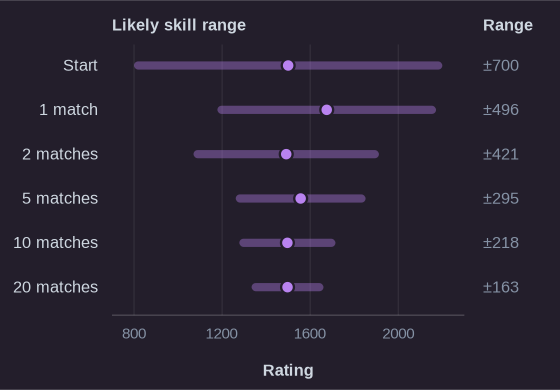
A new player starts with an RD of 350, so their range covers 700 points either side of their rating. From there, RD goes down as they play, because every result is more evidence. It goes back up while they're away, because the longer someone goes without playing, the less sure the system can be that their old rating still fits.
RD then affects every rating change in two ways. A player's own RD sets how far their rating moves: the less the system knows about someone, the further one result moves them. The opponent's RD sets how much the result is worth, because beating someone whose rating is still uncertain proves less than beating someone whose rating is well established.
To see the difference this makes, take two players who are both rated 1500. One is brand new, with an RD of 350, and the other is a veteran with an RD of 50. Each of them beats the same opponent, an established 1500 player whose RD is also 50. This is what each system gives them for the win:
| After the win | Elo, K = 32 | Glicko |
|---|---|---|
| New player (RD 350) | +16 | +175 |
| Veteran (RD 50) | +16 | +7 |
Elo can't tell the two winners apart, so both get 16 points. Glicko gives the new player 175, because it knew almost nothing about them and a win over an established player is strong evidence. It gives the veteran 7, because it was already confident about them. That single game also brings the new player's RD down from 350 to 248.
The loser's rating follows the same logic. The established opponent drops about 5 points for losing to the new player but about 7 for losing to the veteran, because losing to someone whose rating is still a guess says less about the loser. So unlike in Elo, the winner's gain and the loser's loss don't have to match. (These numbers come from Inhouse's Glicko-2 engine. The original Glicko formulas give nearly identical results for this example.)
As the new player keeps playing, their range keeps narrowing. After 20 matches it's about a quarter of its starting width:
Glicko-2: how consistent is the player?
Glicko still makes one simplifying assumption, which is that every player's skill drifts at the same pace. A single system-wide setting decides how fast RD grows while a player is away, and it's the same for everyone. Real players aren't like that. A newcomer might improve every week, a veteran might stay at one level for years, and anyone can go through a slump.
Glicko-2, which Glickman published around 2000, gives each player a third number called the volatility, which measures how much their skill is expected to fluctuate. In Glickman's words, it's high "when a player has erratic performances (e.g., when the player has had exceptionally strong results after a period of stability)", and low when the player performs at a consistent level.
Take a player who is improving fast. Their results keep beating the predictions, so their volatility goes up. A higher volatility keeps their RD up, and a higher RD means bigger rating changes, so their rating can catch up with their real level sooner.
A system-wide constant called τ (tau) limits how fast volatility itself can change. Glickman calls values between 0.3 and 1.2 reasonable, and smaller values keep ratings steadier. An unrated player starts at a rating of 1500, with an RD of 350 and a volatility of 0.06.
Volatility needs batches of games
Glicko and Glicko-2 were both designed to update ratings in rating periods. A rating period is a batch of games that the system treats as if they were all played at once. Volatility is estimated by comparing a player's results over a whole period with what was expected, so it needs a fair number of games to work with. Glickman's guidance is that Glicko-2 "works best when the number of games in a rating period is moderate to large, say an average of at least 10-15 games per player".
Online games usually don't work that way. Players expect to see their new rating as soon as a match ends, so most games update ratings after every match. Each match then counts as its own rating period, and a single result is too little evidence to move volatility much.
Inhouse rates matches this way too, and the effect is easy to see. On our engine, an established player can win eight upsets in a row against opponents rated 300 points above them, and their volatility only rises from 0.06 to 0.0601. So when matches are rated one at a time, Glicko-2 behaves much like the original Glicko, and RD does most of the work.
The three side by side
| Elo | Glicko | Glicko-2 | |
|---|---|---|---|
| Introduced | 1960 | 1995 | Around 2000 |
| Tracks | Rating | Rating, RD | Rating, RD, volatility |
| Player returns after months away | Old rating is trusted in full | RD has grown, so the rating moves faster | Same as Glicko |
| Player is improving fast | Moves as fast as K allows | Treated like everyone else | Volatility rises, if matches are rated in batches |
What came after Glicko-2
Glicko-2 is still a standard choice for one-on-one games. Most of the work since then has gone into things these three systems were never designed for: team games, contests with very large fields, and information beyond who won and who lost.
- TrueSkill (Microsoft Research, 2006). Like Glicko, it keeps a skill estimate and an uncertainty for every player. The difference is that it was built for team games and free-for-alls, so it can work out each player's skill from team results and finishing positions. Xbox Live has used it in games from Halo 3 to Forza Motorsport 7.
- Weng-Lin (2011). An academic method that handles teams and free-for-alls the way TrueSkill does, but with simple formulas that are quick to compute. Open-source libraries implement it under the name OpenSkill.
- TrueSkill 2 (Microsoft Research, 2018). Uses what happens inside a match as well as the result: kills and deaths, quitting, playing in a squad, and the player's experience. On Halo 5 data, its authors report that it predicted match results correctly 68% of the time, against 52% for the original TrueSkill. It launched with Gears of War 4.
- Elo-MMR (2021). Built for contests with thousands of entrants, such as programming competitions. Its authors show that a player can never raise their rating by deliberately doing worse.
Two other changes are worth knowing about, and neither involves new math.
The first is that many games no longer show players their actual rating. In 2013, League of Legends replaced its visible Elo with tiers, divisions and League Points, while a hidden rating carried on driving matchmaking. Many competitive games now split things the same way: a hidden skill rating, often called MMR (matchmaking rating), decides who plays whom, and a visible rank gives players something to climb.
The second is that Elo has spread well beyond games. Chatbot Arena, for example, ranks AI language models using people's votes on head-to-head comparisons. It started with Elo in 2023 and later moved to the closely related Bradley-Terry model, though it still reports scores on Elo's familiar scale.
Where Inhouse fits
Every Inhouse pool runs either Elo or Glicko-2. (A pool is an independent set of ratings, such as one game mode, queue or region.) Elo is the default, with a K-factor that gets smaller as a player's rating goes up. Both engines also rate team matches and free-for-alls. They do it by comparing each side in a match with every other side, so 1v1 duels, team games and free-for-alls are all rated the same way.
On top of the rating, a pool can turn rating ranges into rank bands, for example Gold starting at 1500. It can also keep a player's rating hidden until there's enough behind it. That can mean a minimum number of matches or wins in the current season or, in a Glicko-2 pool, a minimum level of confidence based on the player's RD. The API docs explain how to set up both.
Further reading
- Mark Glickman's Glicko and Glicko-2 pages, including the worked Glicko-2 example
- Herbrich, Minka and Graepel, TrueSkill: A Bayesian Skill Rating System (2006)
- Weng and Lin, A Bayesian Approximation Method for Online Ranking (2011)
- Minka, Cleven and Zaykov, TrueSkill 2: An improved Bayesian skill rating system (2018)
- Ebtekar and Liu, Elo-MMR: A Rating System for Massive Multiplayer Competitions (2021)